CKD often coexists with diabetes, hypertension, obesity, and cardiovascular diseases, presenting a complex management challenge in primary care.
Point-Of-Care Creatinine and eGFR and smartphone based Urine ACR test
Check your kidneys from the comfort of home.
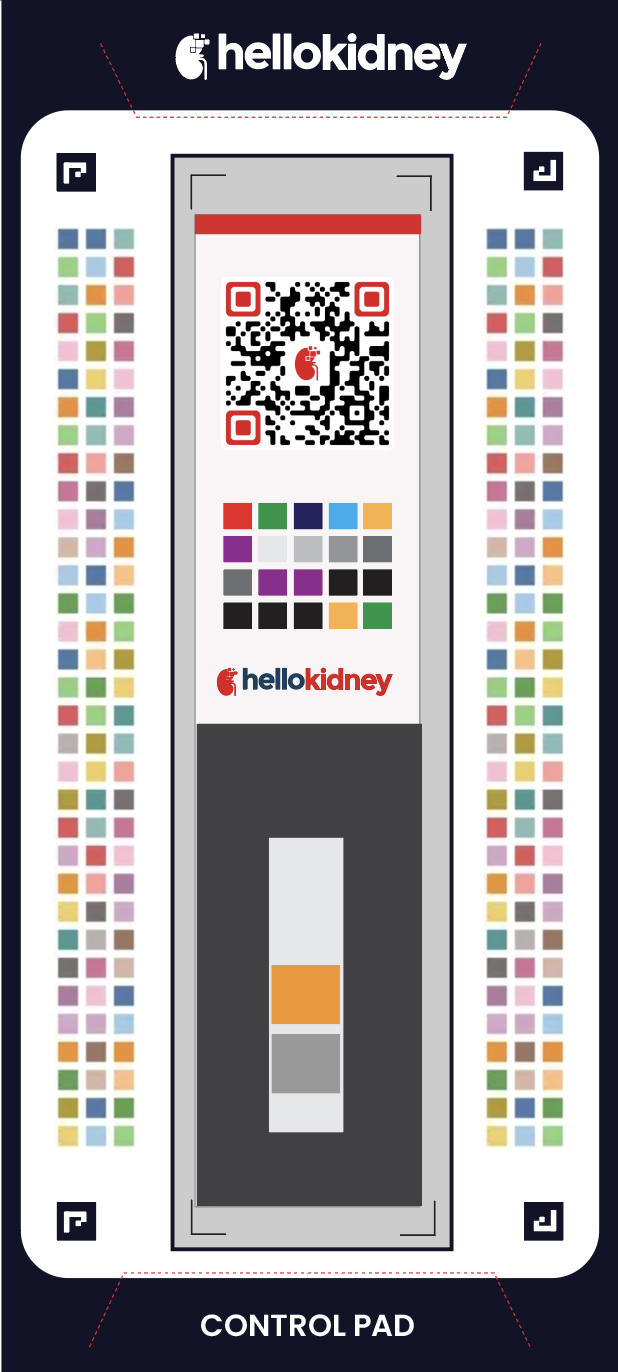
HelloKidney Urine ACR Kit
The urine ACR test strip contains solid-phase reagent areas affixed to a plastic stick. They are provided as a dry reagent. Urine test strips provide a test for semi-quantitative determinations of microalbumin and creatinine, which are markers of kidney damage. The Urine Albumin/Creatinine ratio (Urine ACR) was determined using a two-step colourimetric semi-quantitative point-of-care testing method.
The urine ACR test strip contains solid-phase reagent areas affixed to a plastic stick. They are provided as a dry reagent. Urine test strips provide a test for semi-quantitative determinations of microalbumin and creatinine, which are markers of kidney damage. The Urine Albumin/Creatinine ratio (Urine ACR) was determined using a two-step colourimetric semi-quantitative point-of-care testing method.
Read More.


How it will Work
Collect Urine Sample

Dip the Test Card

Primary care professionals frequently encounter confusion and inconsistency in CKD management, leading to suboptimal patient outcomes.
Scan & upload

NephKare brings the power of KDIGO guideline-based kidney care to the forefront, facilitating early diagnosis and effective intervention.
More about UACR Test
Fairness
001
We’ve trained the model using a wide variety of data so it can give accurate results no matter who you are. The system focuses on medical facts and avoids things like race or income, which shouldn’t influence health decisions.
Transparency
002
The AI doesn’t work like a black box. We use explainable methods so that healthcare providers can understand how it reaches its decisions, which helps build trust. We’re also upfront about how data is used and make sure to clearly point out when the AI is less confident about a result.

Accountability
003
This system doesn’t make decisions on its own—doctors and healthcare professionals still have the final say. We also keep a close eye on how it’s performing, regularly auditing and checking for any issues. If something seems off, we’ve got protocols in place to look into it

Non-Discrimination
004
We’ve put a lot of effort into testing the system to make sure there’s no bias in predicting CKD risk. The goal is to give everyone the same level of care, no matter where they live or their background, and base everything strictly on clinical data.
Clinically Validated by HelloKidney
Over 15,000+ tests completed with rigorous clinical validation and regulatory compliance99.9%
Clinical validation studies
98%
Peer-reviewed research
5000K
Real-world evidence


“HelloKidney ability to create a high quality UI is stands out. It’s something we placed a premium on. A studio with passionate, professional, fun and full creativity. Recommend!.”

Dr. Chinta Ramakrishna
CEO & Founder, Vedanta Hospitals
“HelloKidney ability to create a high quality UI is stands out. It’s something we placed a premium on. A studio with passionate, professional, fun and full creativity. Recommend!.”

Dr. Chinta Ramakrishna
CEO & Founder, Vedanta Hospitals
“HelloKidney ability to create a high quality UI is stands out. It’s something we placed a premium on. A studio with passionate, professional, fun and full creativity. Recommend!.”

Dr. Chinta Ramakrishna
CEO & Founder, Vedanta Hospitals